
Introduction
Is your old phone worth more today than it was six months ago? It might sound unbelievable, because for decades, the rule was you bought something and started its immediate depreciation. But by mid-2026, a market anomaly is emerging: your one-year-old smartphone might be holding its cash value much better than expected. An aggressive component supply crisis (mainly storage and RAM), driven by the voracious building of AI data hubs, is stifling mobile manufacturing.
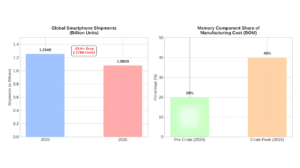
According to revised data from Reuters, global smartphone shipments plummeted 13.9% year-over-year to just 1.08 billion units—an all-time low not seen since 2013.
The Mechanics of Pressure in 2026: AI Hubs vs. the Consumer Market
The reason your current phone isn’t losing value isn’t magic; it’s a raw material bidding war that the consumer market is losing. The memory chips that power our sleek mobile devices are identical to the high-bandwidth components devoured by enterprise AI servers. As tech titans race to build the infrastructure for generative AI, they are aggressively overpricing consumer electronics buyers out of the market; Apple just increase the SRP for their Macs due to Ram shortage.
In Singapore’s import-heavy market, this has triggered a bill of materials (BOM) explosion. Memory components, which once accounted for roughly 20% of a basic smartphone’s manufacturing cost, have skyrocketed to over 40%. With the gross cost of a single gigabyte of RAM doubling in months, manufacturers are facing a grim reality: the “cheap smartphone” is going extinct. Major chip manufacturers are abandoning older, cheaper LPDDR4 memory standards in favor of pricier LPDDR5 formats, imposing a structural price floor that has effectively eliminated the sub-€200 price segment entirely. This shift is particularly painful for brands specializing in AI phones, as these devices demand even more advanced memory architectures to handle on-device processing, further straining limited supply.
Upstream Cost Shifts & Manufacturer Dilemmas
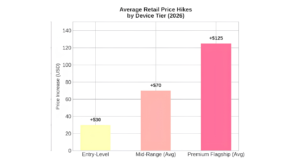
This component shortage is forcing brands into tough choices, and ultimately, part shortages mean mobile manufacturing lines are passing the bill to buyers. Upgrading will be an expensive proposition for most consumers. Each tier has a raw increase in its price – for example: Entry-level devices have an approximate $30 raw price increase, mid-tier (Samsung A57 class) devices will be about $60-$80 higher in raw price than their predecessors, and flagship devices will see a raw increase of approximately $100-$150 over their predecessors.
Now brands can either completely cancel hardware lines to preserve resources or release updated models featuring stagnant specs at heavily inflated retail prices. For conscious consumers in Singapore, this means the shiny new model on the shelf might cost significantly more without actually offering any real, tangible performance upgrades over what you already own. The situation is compounded as chip manufacturers prioritize high-margin enterprise contracts over consumer-grade silicon, leaving even innovative AI phones struggling to secure adequate component allocations.
Why is Your Current Device Resisting Depreciation?
The answer lies in the “artificial scarcity.” With a staggering 174 million fewer new smartphones entering the global supply chain in 2026 compared to 2025, what is arriving feels strangely familiar. We’re witnessing a “spec freeze”—mobile manufacturing brands, desperate to contain exploding component costs, are releasing new models with near-identical technical specifications to their predecessors. Your current hardware doesn’t feel or act obsolete because, on paper, the replacement is virtually the same device in a slightly modified shell.
This trend echoes across the tech ecosystem. We’ve observed immediate price spikes on niche hardware like Steam Decks and Raspberry Pi, while enterprise warnings are already sounding about inflated costs for next-generation gaming consoles. Your smartphone is simply the most visible asset caught in this cross-industry value retention wave. Even the latest AI phones are not immune, as several major chip manufacturers have quietly confirmed that next-gen processor roadmaps are being delayed, further cementing the value of your current device.
The Conscious Consumer’s Perspective: Rethinking “New is Better”
For the conscious consumer in Singapore, this shift demands a recalibration of our purchasing psychology. The longstanding mantra that “new is always better” is being economically outmoded by these supply-side constraints. Trading in a perfectly functional device for a marginal camera upgrade now carries a significant ecosystem cost—not just to your wallet, but to the growing mountain of e-waste we are committed to reducing under the Singapore Green Plan 2030.
If depreciation is no longer a steep cliff, the most sustainable and financially prudent decision is to sweat your assets. Focus on durability and software longevity rather than annual hardware refresh cycles. In a manufacturing landscape where the scarcity of chips restricts the flow of new boxes, holding onto a well-maintained, high-quality device becomes a quiet act of market rebellion and environmental mindfulness.
Want to learn more about used device value? Read here why Singapore needs to embrace recommerce (and how you can help)
Actionable Consumer Strategies
Watching this scene requires a smart tactical shift, and Singapore’s conscious consumers are uniquely positioned to benefit.
- First, consider the financial pivot: opting for a simple factory battery swap over a forced upgrade is a much smarter asset strategy right now, breathing new life into a device that still holds its own.
- Second, you can actively capitalize on residual value. By taking advantage of the 14% global retail price hike on new goods, you can secure exceptionally stable private resale or trade-in rates for your current device if you do choose to part with it.
- Finally, manage your timeline carefully. Prepare for a slow recovery lifecycle, as projections warn that component backlogs won’t normalize meaningfully until 2028. Holding onto quality hardware is no longer just sustainable, it is financially savvy.
Quick Recap
Ultimately, a massive structural crisis has done the unthinkable: it has transformed quickly depreciating tech items into durable financial property. The endless cycle of upgrading every twelve months has officially paused, giving our wallets and the planet a much-needed breather while our current devices maintain their worth.
How is your current smartphone holding up? We highly encourage you to check your device’s current marketplace trade-in quote today here at SellUp—you might be pleasantly surprised by its resilience.
Get the most out of your used devices, check here why recommerce beats trade-ins for consumers.