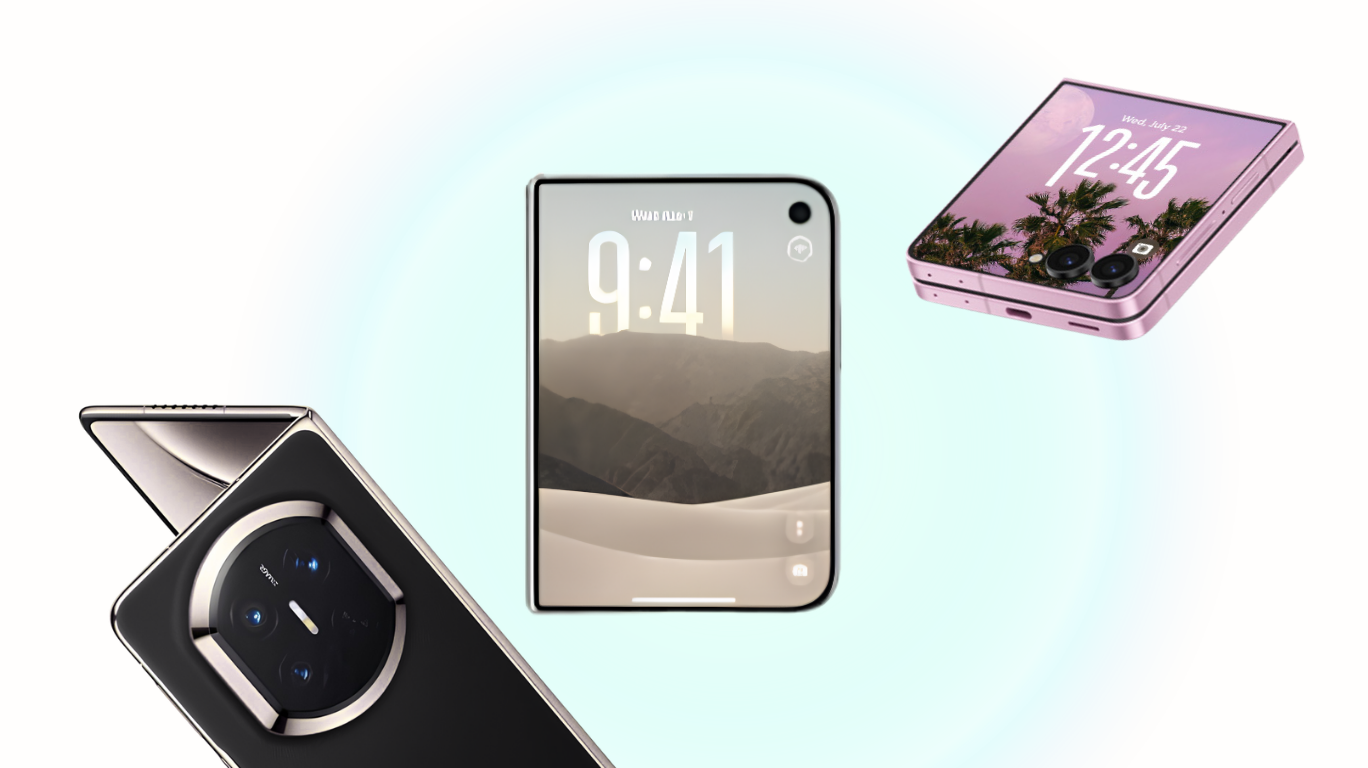
- Technological innovation has changed foldables from weak and rare innovations to durable flagship devices.
- Thin profiles, barely noticeable display creases, high-performance power sources made of silicon and carbon, and superior camera functions.
- Operating system based multitasking and the appearance of iPhone duo is speeding up the popularity of foldable phones in 2026.
Introduction
For years, foldable smartphones remained a fascinating yet compromised niche. That changes in 2026. This article explains how this year marks the definitive tipping point, where foldables evolved from fragile novelties into fully matured, daily-driver flagships.
We examine the market arrivals of the iPhone Duo, Galaxy Z Fold8 Ultra, and Huawei Mate X7, alongside the engineering breakthroughs that finally overcame historical trade-offs—practically eliminating screen creases, boosting battery capacity, and matching the durability of traditional non-folding phones.
Let’s dive in!
Thinness, Creaseless Displays, and Battery Breakthroughs
Shedding the Bulk
The use of cutting-edge liquid metal hinges, titanium frames, and carbon-fiber internal support plates allow foldables flagship to reach thin profiles closely matching standard slab smartphones.
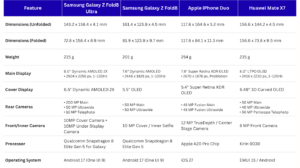
Good examples: the Samsung’s Galaxy Z Fold8 Ultra ranks top at 4.1 mm unfolded and 215 g, whereas the Huawei Mate X7 stands at 4.5 mm unfolded (9.5 mm folded) weighing 236 g. Apple’s new iPhone Duo measures 5.2 mm unfolded, 11.3 mm folded, and scales 254 g. Such materials significantly reduce overall pocket bulk without compromising structural strength.
Near-Invisible Creases
Display durability and optics have reached maturity through refined ultra-thin glass (UTG) formulas paired with flexible titanium and stainless-steel backplate arrays. These underlying mechanical support plates expand during unfolding to form a firm, continuous plane beneath the flexible OLED panel.
By distributing bending stress across a wider radius and removing localized pressure points along the hinge axis, current displays render the central screen crease virtually invisible to the eye and imperceptible to tactile touch during standard daily navigation.
Battery Performance
Before, foldable phones compromised on battery capacity due to space constraints split across two separate chassis halves. The introduction of high-density silicon-carbon (Si/C) chemistries for negative electrodes in 2026 solved this challenge by providing a battery capacity increase of up to 20% over traditional lithium-ion (Li-ion) batteries.
Thus, foldable devices can now use battery capacity of more than 5,000-5,600 mAh while keeping an ultra-thin profile.
Closing the Camera Gap
The Historical Compromise
Initial foldables faced different mechanical camera constraints. Since foldables must integrate dual chassis layers, battery packs, and displays, larger imaging sensors—which inherently require deeper optical assemblies—created excessively thick camera modules.
As design teams prioritized thinner profiles, rear camera depth was restricted, forcing a shift toward smaller physical sensors. So, numerous foldables adopted 1/1.56-inch or smaller sensor formats to preserve internal space and production budgets rather than to execute an intentional optical design.
The 2026 Shift
With the introduction of extremely slim periscope prisms, super-dense sensor designs, and low-profile proprietary optics, manufacturers can now put real flagship cameras into thin foldable shells. For example, the new Samsung Galaxy Z Fold8 Ultra boasts a 200MP main camera, while the Huawei Mate X7 has a 50MP main sensor with a 3.5x optical periscope lens, providing excellent photography and videography capabilities.
Different Strategies
Manufacturers have split into two distinct design philosophies to manage camera module thickness. Companies such as Huawei emphasize uncompromised optical quality with slightly thicker camera bumps to allow for larger main sensors, as well as variable aperture sizes in order to capture pictures in low-light conditions and control depth.
Other manufacturers such as Samsung focus on making cameras ultra-thin and user-friendly, relying on image cropping based on high-resolution sensors and a combination of computational photography techniques to achieve zoom and clarity while keeping mechanical sizes thinner, and more streamlined than the competition.
Multitasking and App Ecosystems
Foldables frequently rendered standard smartphone apps as stretched, low-density displays. With the development of the operating system Android 17 and iOS 27 in 2026, it is now mandatory for all mobile phone applications to be responsive, meaning that these programs will expand according to the size and dimensions of a display and not merely stick to rigid proportions.
Users can partition the large internal panel across multiple floating windows, leverage fixed dock taskbars for fast toggling, and intuitively drag and drop assets between active apps. Unfolding hardware instantly migrates foreground tasks from exterior panels onto expanded displays without causing layout disruption or application resets.
Top 5 Foldable phones in 2026
The iPhone Duo Arrival
Apple’s late entrance into a hardware segment tends to increase the available market, rather than just redirecting old sales. This can be seen for every product: the compatibility of the iPod with Windows allowed the company to reach a wider audience than just Mac users, and the success of the iPhone is always linked to the growth of the smartphone industry.
For the case of foldable devices, experts believe the iPhone Duo to transform a well-known niche into a widely-used segment, with Apple’s existing user base providing a ready audience that does not need to be convinced of the form factor’s relevance.
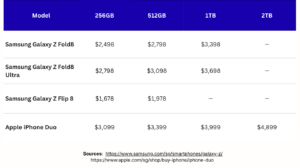
Pricing
Quick recap
Foldable smartphones have officially crossed the threshold from experimental novelties into refined, daily-driver flagships. Thanks to innovations such as silicon-carbon battery technology, virtually undetectable hinge designs, and the introduction of multi-tasking functionality at the OS level, 2026 is a definitive turning point for foldable phones.
While ultra-premium pricing keeps these devices firmly at the top of the market, the entry of major players like Apple—alongside unprecedented engineering convergence—ensures that foldables are no longer a compromise, but rather the new standard for modern mobile productivity and hardware innovation.