Introduction
In 2026, the “iterative” updates of the past have been replaced by aggressive hardware leaps driven by on-device AI. If you are currently holding an iPhone 16 Pro, the question isn’t just about a shinier chassis; it’s about whether the iPhone 17 Pro offers enough technical daylight to justify the investment. This guide breaks down the critical shifts between these two powerhouses.
We will analyze the silicon transition from the A18 Pro to the A19 Pro, evaluate refined design languages, and scrutinize camera and battery advancements to help you decide if it’s time to trade in.
Core Hardware and Performance Differences
A19 Pro vs. A18 Pro
With its A18 Pro processor utilizing an elaborate 3nm process, the iPhone16 Pro has been excellent at providing impressive single-core and GPR performance across virtually every application — from 4K video editing down to gaming quality similar to a console. TSMC used their first gen 2nm node to produce the iPhone 17 Pro’s new A19 Pro CPU, which is 20% faster than the previous generation’s ADB, and also delivered 30% better performance with its new 8-Core GPU supporting hardware ray tracing as well as a next-generation neural engine capable of double-machine learning throughput. This will result in much smoother, on-device real-time Image generation, quicker photo processing, and cooler-long-lasting gaming from large improvements in efficiency.
As impressive as the A18 Pro chip is, its successor’s improvement to architecture provides increased confidence in how capable we’ll continue seeing the iPhone be on future applications that will utilize increased use of A-I technology.
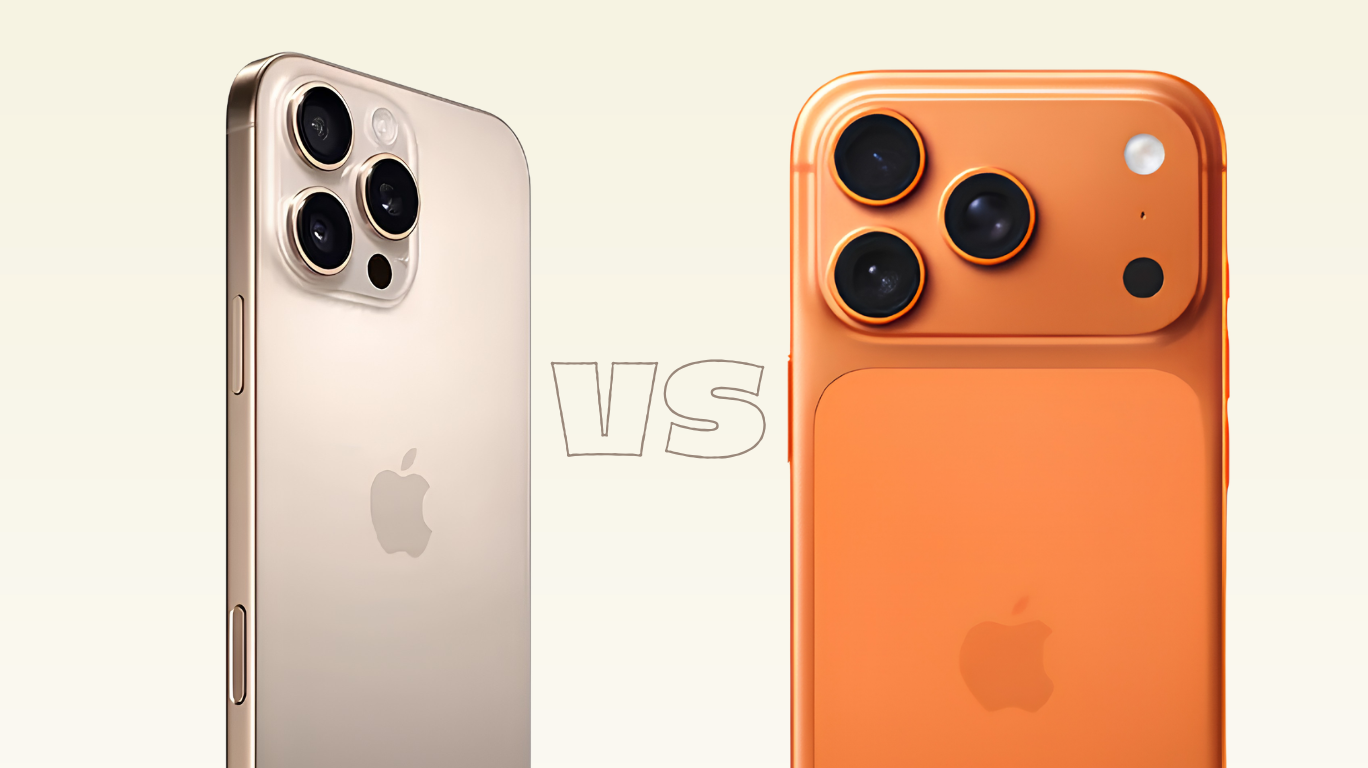
This iPhone 16 pro vs iPhone 17 pro comparison wouldn’t be complete without also examining the new design and display.
Display and Design Enhancements
While the iPhone 17 Pro matches its predecessor in terms of aesthetic characteristics, such as flat edges & having a titanium frame, it has a few improved components that provide better user experience. The most significant is the shift to an under-display Face ID, which has allowed Apple to replace the Dynamic Island cut-out with an unobtrusive camera and take advantage of more screen space without the need to expand the physical size of the phone.
In any iPhone 16 pro vs 17 pro analysis: the screen is a key factor The Super Retina XDR display now has a brightness level of 3000 nits, making it easier to use outdoors, while the new anti-reflective ceramic shield essentially eliminates glare.
The build quality of the 17 Pro has been improved due to the addition of solid-state haptic buttons, which allow the user to customize their button press feedback, along with a new micro-blast surface finish that does not leave fingerprints. These improvements allow for a better viewing experience, while also making the 17 Pro easier to carry around with you daily and more durable.
Camera System and Photography Upgrades
Sensor Improvements and Zoom Capabilities
In this iPhone 16 pro vs iPhone 17 pro, the camera is the main differentiator. While the iPhone 16 Pro can shoot with its 12MP telephoto lens up to 5x optical zoom, the iPhone 17 Pro has been upgraded to a 48MP telephoto lens that uses a folded sensor and this enables three separate zoom levels – 4x at full resolution of 48MP, 8x with pixel binning allowing for almost no loss of light, and 16x upscaled digitally to look almost identical to optical performance.
Therefore, in actual usage, the 4x will reveal much more detail in portrait shooting compared to the 5x of the iPhone 16 Pro, and the 8x will outperform the iPhone 16 Pro at both resolution and color accuracy in low light. Furthermore, because of the improved sensor-shift stabilization with the Fusion camera, the iPhone 17 Pro offers an entirely new way to think about how far a pocket camera can shoot.
Video and Content Creation Workflows
For professional use, Apple’s Log 2 feature elevates mobile workflows since the iPhone 17 Pro delivers a greater range of dynamic color with better overall grading options than the original Pro’s Log profile did. Professionals can also capture ProRes RAW files via external drives at higher frame rates than before — perfect for high-end cinema productions! And even the front-facing (selfie) camera has been improved significantly by moving up from a 12MP sensor to a 24MP, multi-aspect image sensor – resulting in a wider angle for 4K video blogging and improved depth-of-field, making it a legitimate B-camera option for serious vlogging content creators!
Ready to upgrade your mobile? Check here when is the best time to sell your iPhone 16 in Singapore.
Battery Life and Daily Performance
There is a massive improvement in battery life in the new generation. The stacked battery architecture in the iPhone 17 Pro gives it an additional 15% of capacity, without adding any thickness – for example, it can now offer up to 27 hours (instead of 22 on the iPhone 16 Pro) of video playback capabilities.
The charging rates have also improved drastically. The maximum wired fast charge rate for iPhone 17 Pro is 45W (0-50% in 18 minutes), and when using MagSafe 3 compatible accessories, it can charge at a maximum of 30W. More importantly, the way they perform continuously under heavy usage also vary greatly between devices.
After 12 minutes of continuous gaming or AI processing, the A18 Pro processor in the iPhone 16 Pro will reach thermal throttling; whereas the improvements made to the vapor chamber of the A19 Pro processor in the iPhone 17 Pro allows it to stay at peak clock speeds for more than 30 minutes.
Is It Worth the Upgrade in 2026?
This iPhone 16 pro vs iPhone 17 pro comparison is summarized for quick reference
| Feature | iPhone 16 Pro | iPhone 17 Pro |
| Processor | A18 Pro (3nm) | A19 Pro (2nm) |
| Memory (RAM) | 8GB | 12GB |
| Telephoto Lens | 12MP (5x Optical) | 48MP (4x / 8x Fusion) |
| Front Camera | 12MP | 24MP Multi-aspect |
| Peak Brightness | 2,000 nits | 3,000 nits |
| Max Charging | 27W Wired | 45W Wired |
| Cooling | Graphite sheets | Vapor Chamber |
Conclusion
The iPhone 17 Pro doesn’t just iterate—it substantively redefines the Pro experience. The 2nm A19 Pro delivers AI-ready horsepower with vastly improved sustained thermal performance, the under-display Face ID and brighter anti-glare display modernize the design, and the 48MP telephoto with lossless 4x and 8x zoom transforms mobile photography. Creators gain genuine professional tools in Apple Log 2 and multi-lens ProRes RAW, while a larger stacked battery and long-overdue 45W charging eliminate range anxiety. If you’re using an iPhone 16 Pro, these upgrades are luxuries, not necessities—but for those who push hardware limits daily, the 17 Pro justifies its price as the most capable, future-resilient iPhone yet. In 2026, it’s a definitive yes for power users.
If you’re willing to say yes to the iPhone 17 Pro, read here to find out where to sell your iPhone in Singapore and get the best deal!